Showing posts with label Directing. Show all posts

Saturday, November 30, 2013

The Process of Directing

Let me begin by saying I've received awesome news in the past few weeks. First, my USC second semester film "One on One" has been accepted into The San Diego Black Film Festival.
You can check out more info HERE. My film also received an Award of Merit in the African American category of The Accolade Competition
You can check out the link HERE. I'm waiting to hear back from other competitions and festivals, but it was amazing to receive good news from these ventures. 

My third semester at USC's School of Cinematic Arts has been focused on cinematography and learning the in and outs of rental houses. I'm taking an intermediate cinematography class with Director of Photography, Linda Brown, while working at Panavision. Outside of class, I've focusing on honing my directing chops. I directed a comedy sketch for the group, Wolf Punch Comedy
I directed an episode of the webseries, Black Man Depressed. 
Each of these projects are in post-production. I'll have the chance to show them at the beginning of next year. For now, I'm in the production stage of a webseries I'm directing called "Sassy Batman." 

These past few gigs directing have been immensely rich. I've focused on Uta Hagen's "Six Steps", studying character and structural beats, character arcs, motivation, and the proper usage of verbs to communicate with actors. It's difficult putting these techniques into action, especially on set. When you're in the thick of shooting you're usually thinking on your feet. I've found that sitting down with your actors beforehand, and discussing the intention of their characters leads to a smoother actualization of your ideas. 

Giving them objectives for the scene, conscious and unconscious goals, plus asking them ambiguous and direct questions allows them to create a foundation for their role. The best outcome arrives when an actor formulates a new path for a character you didn't realize based on discussion. It's the intimate relationship between directors and actors which shines through these techniques, questions, discussions, and research. 

The process of directing is arduous. It is commanded by an innumerable amount of ideas, provisions, and strategies. Still, there is a large chunk completely dependent upon chemistry, luck, and physical play. During the Wolf Punch's Daisy's Enfeugo sketch, I repeatedly swooned with one my actors to help her feel "dainty." A few shots later I was jumping/high stepping with my actors right before shouting action. I wanted to ensure their pile-drive into the third character felt authentic. There's a set of guidelines towards bringing the best out of your actors, but there are instances when your instinct serves you best. 

Granted, I'm still learning. I admit this. I'm proud of it. I'm growing. Each time I'm on set working with actors I sense growth, a maturity in my direction. I couldn't ask for more. 


Wednesday, October 2, 2013

Freedom Comes With Preparation: Shot Lists, Floor Plans, & Storyboards

One of the things I hate to hear whenever I’m working with a Director or DP is let’s “free-flow it.” Sometimes this is a necessity if you’re going into a location where you’ve had no chance to scout or see pictures. 
In most instances, it’s the case of the Director and/or DP being lazy. The freedom to try different ideas, shots, and camerawork should stem from a complete understanding of what you need. 
It is assured you’ll hit a point on set where you don’t know the next shot without preparation. Your crew begins to question your vision of the film, scene, short film, etc…

When you prepare beforehand, you give yourself freedom to play on set. When you know the shots you absolutely need it allows you to add, cut, or combine shots after each performance. 
An understanding of your scene gives you the opportunity to play with your actors. You can focus on performance rather than worrying about if the scene will play out correct in the editing room. 
It also gives your crew the reassurance you understand your role as the Director or DP. A crew or cast that doesn’t respect you will not yield positive results. 
In this post I’m sharing a few pages from the shot list, shooting script, and floor plans I put together for a comedy sketch. The entire sketch had an ensemble cast (six actors) plus three separate scenes. It was one location, but we also had the use the same location to “create” a TV commercial to transition into the scenes afterward. 


By the end of the day, after reviewing my entire Director's Book, I had cut four shots, combined two, and added three. I wouldn't have been able to do so without prior preparation. Once I marked all each cut, integration, and addition I handed an extra copy to the producer. 

The final Director's Notebook included character analysis, character and scene beats, shot list, shooting script, and floor plans for the editor. If I'd been more diligent I would've included storyboards and possibly my version of how I'd cut the scene based on the day's work.

More importantly, my previous preparation allowed me to put down my notebook and focus on the actors since I had everything planned out in my head, but I could always reference myself when I was unsure. 
A good director and/or DP realizes freedom comes with preparation. Remember this on your next shoot. 


Tuesday, June 12, 2012

Superstar

Mission accomplished once again everyone. 

"Gifted Johnson"-Photo courtesy of Sumerlin Photography

I recently finished working as Director of Photography on the music video for R&B artist, Gifted. The guy is an eccentric fuse of positive energy, catchy lyrics, and superb beats. Gifted's songs emanate experience. He has a lengthy songwriting credits, the most notable being Ne-Yo, Jagged Edge, and Bei Maejor. Point being, he understands how to make a hit.

Gifted has performed on staged with Miguel, Brian McKnight, and Marques Houston so his experience within the music industry is extensive and rich with stories of high-profile meetings and hobnobbing with the famous. He has been around the block. After writing and performing for those who have gained notoriety, he wants to build a cult of personality all his own.

The song is called, Superstar. Produced by Bei Maejor, the song retains a flirtatious, and upbeat spirit. It sounds like a song you would constantly turn up when you're listening to the radio. This is where the music video comes in.

Friend and colleague, Micah Russell, pitched the idea. He wanted a music video with influences from a notable amount of current artists including:

Kanye West


Miguel


Fitz and The Tantrums


Usher

Micah's treatment (a write-up of a creative idea for a music video) revealed an interest in mixing various eye-catching colors during performances of the song within a studio (Miguel, Fitz and The Tantrums, and Kanye) while interlacing narrative style imagery from outside locations and clubs (Usher). It became my job to create an atmosphere worthy of each of these scenes.

The first thing I began working on was lighting plans (a floor plan detailing the movement of talent and where lights will be placed to illuminate them) for the entire music video.

These lighting plans encompassed the entirety of the shoot for each day. I set up floor plans for various scenes such as within a club or studio style lighting.

Photo courtesy of Sumerlin Photography


The experience was amazing. Now that my job is done, I'm looking forward to seeing what the editor brings together. Until then, check out this Behind The Scenes video highlighting me as well as my director and other individuals who made the project come together.


Sunday, February 5, 2012

Campus MovieFest 2012 - I.F.

Another Campus MovieFest has come and go! It's amazing to think it's only been a year since I took up my own reigns and made my first Campus MovieFest film as a director. Now I'd like to present my latest short film, I.F.


In comparison to last year I wanted a complete film, rather than a silent film interlaced with a song. Last year, people were either fascinated or taken aback by my decision to use a puppet as the lead protagonist in the film. Whether or not someone enjoyed it, they all admitted that one irregularity in the film made them keep watching. 

This year, I wanted a stronger story, actors, and aesthetic look, but I wanted to keep one idea from Bottom  of a Glass; I wanted to retain the one irregularity in an otherwise tried and true story. Bottom of a Glass represented the despair and final ascension from pain for a grieving father. The fact the father was played by a puppet gave it a dynamic many were not expecting. 

In the same way, I.F., entails the story of a young child losing her parents and being forced to live a relative. Its unique dynamic stemmed from the inclusion of I.F. (Imaginary Friend) who is sent to help Jordan cope with the loss of her parents.

I hope you like the latest short film. Unfortunately, we were not able to bring home Best Picture of Best Drama this year, but I'm happy with the film I've made.

Let me know your thoughts in the comments!

P.S. We are in the running for CMF's Wild Card Entry. If we get the most views by March 3rd my team and I will still be able to travel out to Hollywood to see our film compete. Please take out the time share the film with anyone you know!

Here is the LINK


Saturday, January 28, 2012

Making a Pre-Production Package - A Word To New Filmmakers

As a filmmaker I can't stress enough how important it is to make a detailed binder that completely encompasses your entire film. One of the problems you get with people who are creative is the fact they come up with amazing ideas, but they can never make it a solid, tangible package.

They're too busy making one awesome idea rather than building an entire story. It's cool to have a gimmick or set up the story is based around, but without a good story you have nothing. When it comes to film, you really need to have everything planned out even to the most minute detail. Many filmmakers rush a film without planning the logistics and fail. Here are two rules you can live by.

1. A scene will always take longer than what you predict
2. It's not if a mistake will happen. It's when.

This is why you want to be as organized as possible. So I want go over how I make a production package.

1. Actor's Info, Crew Info, Location Info, Prop Info, Contracts (Actor's Release, Location Release, etc...)
2. Script
3. Shot List
4. Storyboard
5. Floor Plan
6. Scheduling
7. Shooting Script
8. Visual References
9. Revised Pages
10. Equip List
11. Miscellaneous


This may seem overboard, but I'm going to explain each one and why you should do it.

First, get notebook dividers that have numbered division. You can also get colors, it doesn't matter. Just make sure to buy enough to throughly divide your work.

Before I begin on the first page.

 I have one lone page that has my logline, a short description of the film (two paragraphs usually), and then a story summary (around four to five paragraphs). You need to be able to explain your film in one sentence or in a few paragraphs. In the story summary write out your first act, second act, third act, and conclusion. Do not skip over a part of your story you are unsure of. If you have not figured it out in your summary, you probably haven't fleshed it out in your script.

1. The first divider will be for all of the actor's info, crew info, contracts, location info, and props. As you are looking for actor's and locations write down who the person is or who owns the location. Write down all the props you'll need to buy for the film. This will help you to keep everything you are doing at the beginning of pre-planning in check. Be sure to get Actor Release Forms and Location Release Forms to avoid legal trouble. You can find pre-made ones anywhere online.

2. This is a no brainer. You must have a script before shooting a film. Don't wing it. Don't say I have it all in my head. You don't! You are going to waste someone's time if you don't put it on paper. When you write the script follow proper screenplay format.  Download screenwriting software, Celtx. Have someone else read your story. You will always be bias to your work. You will always think it's good when it might be a polished turd.

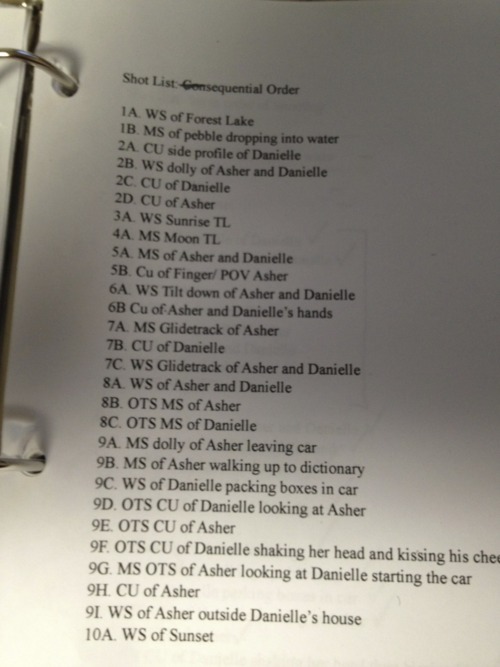
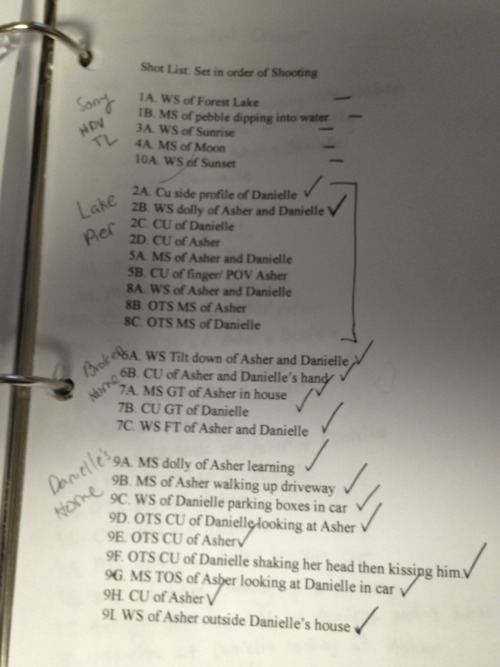
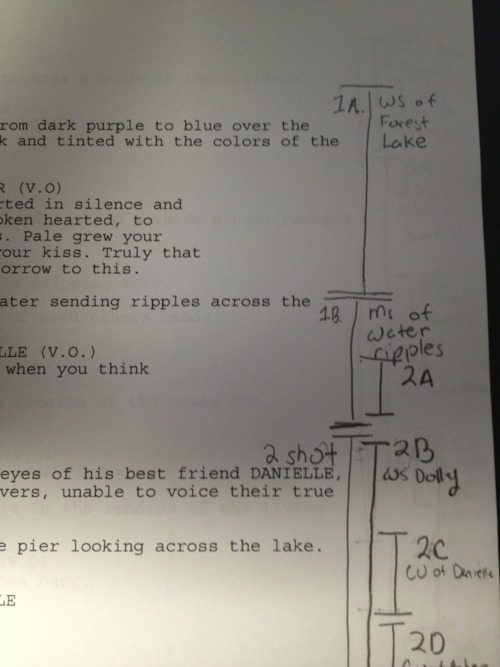
3. Your shot list covers all of the shots you will need in your film. This ties in with your storyboard. You might end up doing them both at the same time or one before the other. It's based on you, but I recommend doing your shot list first. Go through your script and visualize every scene (how you place your characters, where do cuts happen, movement, etc...) and write out what it would look like.

Ex.
Scene 1A - Medium Close Up of Emma sighing and reaching for pen
Scene 1B - Close Up of hand reaching for pen
Scene 1C - WS of Emma picking pen up then standing up and walking out of room
Scene 2A - WS of Emma walking out of room and into hall

Shot List in Consequential Order

Shot List Based on Scenes we will shoot based on availability of actors and locations

Those were a little more detailed than what you'll need, but it's your preference. Go through your entire script and figure out how many shots you'll need and list them by scene, then in order alphabetically.

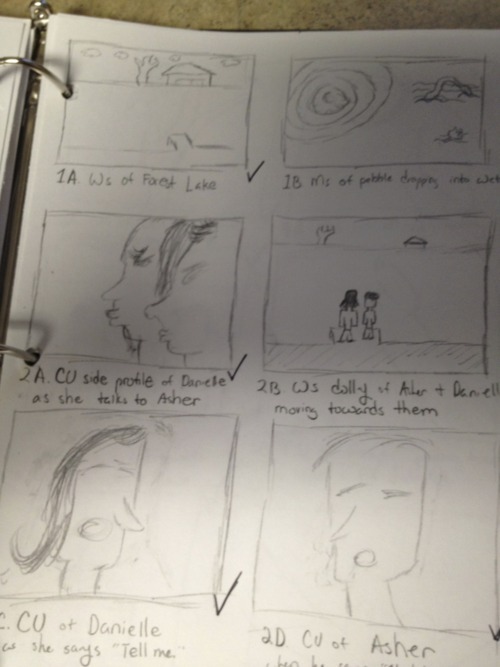
4. Your storyboard is the visual representation of your film. It is (in my opinion) one of the most important parts of understanding your film's aesthetic.  You may say, 'Well I can't draw."


Tough luck, draw stick figures because you NEED to do this. If you're ashamed of your drawing skills sit down with someone who can help you visualize. This will be tedious and time consuming. Do it. You will thank me later.

5. So you've figured out your shots and have a decent storyboard. Cool, during this time you should be out scouting location. Take a camera with you and photograph all angles of the location. If you don't have a camera handy (YOU SHOULD! Why don't you have your own camera! You love film don't you! Eat Ramen Noodles and save up those pennies!) take the photos with your phone.

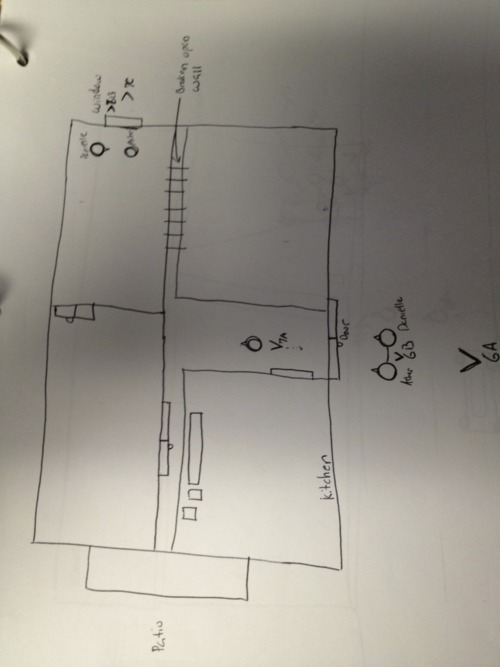
Once you have the pictures it's time to make an outline of the location from a bird's eye view. Account for tables, chairs, extra rooms, etc...)

You'll notice that ovals with small triangles on them and V's on the paper. The ovals represent the actor's blocking and the small triangles represent his nose. This is so we know where the actor is facing and the direction of camera's shot.

6. I did not put anything into the binder for scheduling since I constantly updated scheduling through email and Google Docs. Once you have locations and actors you're going to need to figure out when they are available. You also need to know (based on your script) what time of the day you want certain scenes to be shot.

You will then need to  coordinate with your actors and crew for Crew Call (when the crew must be at the location) and Actor's Call (when actors must be at location),  what days and times you'll have certain actors, what days and times you'll have certain locations, and (based on the previous) when you can shoot certain scenes. I've done this on my own several times. I don't like it, so I usually work with or hire a Producer (individual who handles the non-creative logistics such as telling actors where and when to be, figuring out your film budget, etc...) who will look over all of this and figure it out for me.

A Producer is invaluable. Even in college, if you want to have a smooth film, you should go ahead and link up with individuals who take themselves seriously, and enjoy brining a film together on the business side.

7. This one is pretty simple. Remember when I told you to visualize how each scene in your script will happen shot by shot? Now, put your shot list on the side of your script by where it corresponds with the script. Do this to your entire script.


8. Visual References are just pictures, notes, poems, or anything that embodies the aesthetic your film is trying to achieve.  For this pre-production package, I wanted a sense of destruction counteracted by the beauty of nature (specifically a lake). Here are two of my visual references.

9. NEVER throw away anything. Even when you are done with it you never know when something may fall out or you forget an updated script or shot list. At least if you have your old work you can go back and try to remember what you revised. Never throw away anything you've written.

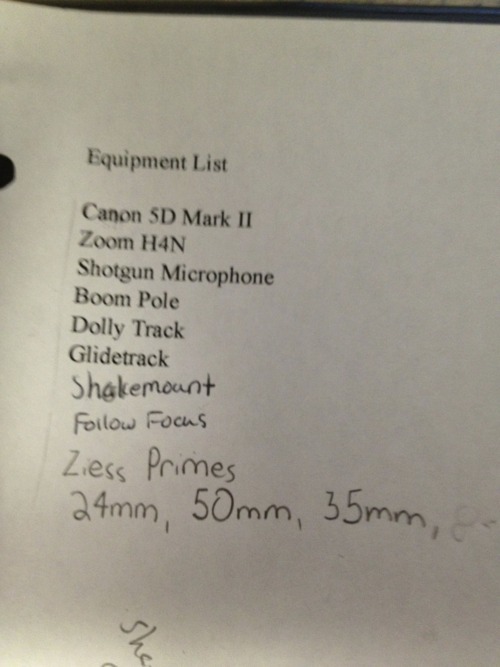
10. This one is straightforward. Just write out the equipment you feel you will need to finish this project.


11. Finally, anything else that doesn't fit into these categories will go into Miscellaneous.
That's a full production package. Next time you shoot a film take out the time to make something extensive and detailed. If you think this is overkill, I assure you you're going to have a hard time making your vision come to life.

Film Made With Production Package You Saw: 


lens rental


Thursday, June 23, 2011

Campus Moviefest: International Grand Finale


It's an interesting phenomena when you find yourself in a situation which embodies itself as the culmination of an entire year's worth of work. It feels as if I've been gradually building up to the moment I made it back to California..

June 17 passed a few days ago. This marked the one year anniversary of Que The Lights. From the beginning I set a simple, yet honest goal, establish myself as a legitimate filmmaker. What do I mean by legitimate?

Honestly striving to create a powerful body of work uniquely my own. I wanted to produce my own web of artistic design which displays a quality of work capable of standing on its own.

I believe I've done this to a degree. I still have a bevvy of work left to finish, start, and create, but this year has been a significant kick-start. Where I am gives validation to the words I set forth over a year ago.

Two of my films are in competition at CMF's International Grand Finale. The first is "Bottom of a Glass" and the second is "Portrait of the Storm: Tuscaloosa, AL."

"Bottom of a Glass" will be competing in the Best Drama section while "Portrait of the Storm" will be competing in the 3D competition.

Along with my own, others films from Alabama such as "Sugarbaby", "Blue Barry", and "A Certain Woman" will be in competition and screened. You can find more info here.

CMF is also providing student's with another great opportunity, the ability to meet with Hollywood executives, agents, and directors. This does not guarantee any individual a ticket into the inner-workings of the industry, but it does carry the potential of garnering valuable experience when we're thrown into the real world.

This is why they asked us to not only bring our resumes, but be ready to show our demo reel if asked. A demo reel is essentially a compilation of your best work edited into a single piece. It's your calling card to the industry and signifies the strength of your work as a filmmaker.

Check out mine and let me know what you think,


Director/DP Reel 2011 from Xavier Burgin on Vimeo.

This is why this moment truly signifies a round-up of this year. All of my best work tightly wrapped in about two minutes. It seems so small, yet every drop of sweat, long night story-boarding, headache induced irritation via shot listing, and carpal tunnel-esque bout while revising a script is somewhere simmering within this reel forming my hopes for a successful future.

Wish me luck this weekend. Hopefully my work won't need it.


©2010-2011 QUETHELIGHTS| DESIGNED BY JAY DAVIS